
Skip to content
LEAF logo
LEAF logo
DONATE
DONATE
MENU
LEAF logo

Contact

DONATE
DONATE
Informations en français
  • English
  • Français
  • About
    • Our Story
    • Mission & Vision
    • Staff
    • Board
    • Law Program Committee
    • FAQs
  • Cases and Law Reform
    • Our Work
    • Issue Areas
      • Reproductive Justice
      • Indigenous Rights and Law
      • Identity-Based Oppression
      • Hate Speech and Online Hate
      • Sexual Assault and Consent Law
      • Gender-Based Violence
      • Access to Justice
      • Workplace Rights
      • Socio-Economic Rights
      • Family Law
    • Search Cases & Submissions
    • Current Work
      • Accountability Project
      • Avenues to Justice
      • Strengthening Community Capacity
      • Technology-Facilitated Violence
      • Valuing the Care Economy
    • Past Projects
    • Legal Resources
  • Education
    • Overview
    • Workshops, trainings & webinars
    • Factsheets & infographics
  • News & Events
    • Search News & Events
    • Events
  • Publications
    • Search Publications
    • Working Papers
    • Reports
    • Annual Reports
  • Regional Branches
    • Overview
    • LEAF Calgary
    • LEAF Edmonton
    • LEAF Hamilton
    • LEAF Kitchener-Waterloo
    • LEAF London
    • LEAF Newfoundland & Labrador
    • LEAF Ottawa
    • LEAF Saskatchewan
    • LEAF Sudbury
    • LEAF Toronto
    • LEAF Windsor
    • LEAF Winnipeg
  • Get Involved
    • Ways to Get Involved
    • Donate to LEAF
    • Join a Branch
    • Volunteer
    • Become a LEAF Pro Bono Lawyer
    • Partner with LEAF
  • About
    • Our Story
    • Mission & Vision
    • Staff
    • Board
    • Law Program Committee
    • FAQs
  • Cases and Law Reform
    • Our Work
    • Issue Areas
      • Reproductive Justice
      • Indigenous Rights and Law
      • Identity-Based Oppression
      • Hate Speech and Online Hate
      • Sexual Assault and Consent Law
      • Gender-Based Violence
      • Access to Justice
      • Workplace Rights
      • Socio-Economic Rights
      • Family Law
    • Search Cases & Submissions
    • Current Work
      • Accountability Project
      • Avenues to Justice
      • Strengthening Community Capacity
      • Technology-Facilitated Violence
      • Valuing the Care Economy
    • Past Projects
    • Legal Resources
  • Education
    • Overview
    • Workshops, trainings & webinars
    • Factsheets & infographics
  • News & Events
    • Search News & Events
    • Events
  • Publications
    • Search Publications
    • Working Papers
    • Reports
    • Annual Reports
  • Regional Branches
    • Overview
    • LEAF Calgary
    • LEAF Edmonton
    • LEAF Hamilton
    • LEAF Kitchener-Waterloo
    • LEAF London
    • LEAF Newfoundland & Labrador
    • LEAF Ottawa
    • LEAF Saskatchewan
    • LEAF Sudbury
    • LEAF Toronto
    • LEAF Windsor
    • LEAF Winnipeg
  • Get Involved
    • Ways to Get Involved
    • Donate to LEAF
    • Join a Branch
    • Volunteer
    • Become a LEAF Pro Bono Lawyer
    • Partner with LEAF
Home / Module 1: What is feminist strategic litigation (FSL)? 

Module 1: What is feminist strategic litigation (FSL)? 

Before we define feminist strategic litigation (FSL), let’s break down what we mean when we say feminism. For LEAF, feminism is: 

  • A movement which looks to end sexism and which opposes patriarchy 
  • Grounded in the framework of intersectionality, a term coined by Kimberlé Crenshaw 
  • Trans inclusive 
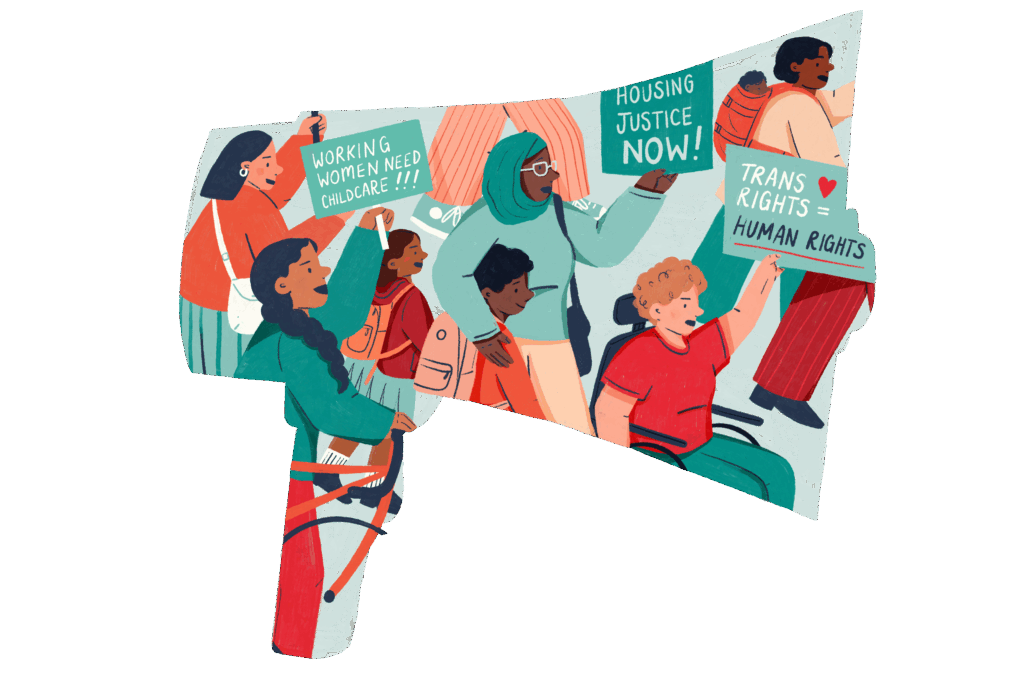
Illustration of a crowd of people at a protest, all holding feminist signs. The shape of the illustration is a megaphone
Reflection questions: What does feminism mean to you? What are some feminist issues that are important to you?
Now, onto feminist strategic litigation: 

Feminist strategic litigation is a systems-change strategy that uses the courts. It involves working together with feminist lawyers, on cases involving feminist issues, with systemic feminist goals.

In other words, FSL looks like feminists getting involved in a court case that has the potential to result in systemic change, that is, impacts for others besides just the parties in the court case. This doesn’t necessarily mean you have to go to court to do FSL (as we’ll get into in Module 3), but FSL does always revolve around a court case.  

This also doesn’t mean that court cases that don’t have a systems change component aren’t important – every single court case has very real impacts for those involved – but when it comes to defining feminist strategic litigation, we’re looking for cases that will have broader feminist impacts for others beyond just the parties involved in the case. 

Illustration of four femme people supporting each other as they move upwardly on a ramp comprised of papers and a gavel
Let’s have a look at how other gender-based violence (GBV) advocates define feminist strategic litigation:

FSL is just one systems change strategy, and is often used alongside other systems change strategies that you may be familiar with. 

Education
FSL
Law reform
Advocacy
Grassroots organizing
Research
Here are just some examples of systems change strategies. Are there any others you can think of?
Click on each circle to learn more!
Sharing information and resources
Working together with feminist lawyers, on cases involving feminist issues, with systemic feminist goals
Pushing for changes to laws and policies
Influencing decisionmakers and politicians
Mobilizing local communities
Gathering facts and evidence

Test your knowledge 

Take a look at the following court cases. Do you think each case involves FSL? Why or why not?

Hint! Ask yourself: Does this case involve a feminist issue? Does it have the potential to result in systemic change?

1) A province has a rule that allows people over the age of 14 to apply to change their designation of sex on their birth certificate if it does not correspond to their gender identity. They can choose male or female. Several non-binary individuals and a national 2SLGBTQI organization bring a lawsuit. They claim that the rule violates their rights under the Charter of Rights and Freedoms and that there should be a non-binary option available. 

Answer

Yes, this is FSL. There is a feminist issue involved (equality for non-binary people), and the outcome would impact not just the parties in the case, but all non-binary people in the province who may want to change their sex designation on their birth certificates to a non-binary option. This example is based on a real case. 

2) A woman and her husband are getting divorced. They go to court to determine spousal support, child support, and the division of their property. The husband abused and coercively controlled the woman throughout the marriage. The parties can’t agree on the husband’s income or the value of their house, but both parties ask the court to apply the usual rules for determining support and property division. 

Answer

No, this isn’t FSL. There is a feminist issue involved (intimate partner violence and coercive control), but the outcome won’t impact those beyond the parties in the case because they have asked the court to apply the usual rules. If there was an attempt to change the usual rules, then this case would be FSL because changes to the rules would impact how future cases are decided. 

3) A woman and her husband are getting divorced. They go to court to determine spousal support, child support, and the division of their property. The husband abused and coercively controlled the woman throughout the marriage. The woman specifically asks the court for damages for the family violence she suffered. The judge agrees, creates a new tort* of family violence, and awards the woman $150,000. 

Answer

Yes, this is FSL. There is a feminist issue involved (coercive control), and the creation of the new tort of family violence not only impacts the parties in this case, but would allow others who experience family violence to seek damages using this new tort. This example is based on a real case. The decision to create a tort of family violence was appealed, and it’s currently up to the Supreme Court of Canada to decide whether to re-implement it. 

Remember, the critical piece to keep in mind when determining whether a case can involve FSL is the systems change aspect. If a court case has the potential to have feminist impacts on people outside of the parties directly involved in the case, then it is FSL! 

Additional resources

  • Video: The urgency of intersectionality | Kimberlé Crenshaw
  • Statement: Our feminism is trans-inclusive 
  • Factsheet: What is feminist strategic litigation?  

← Back: Courting Change homepage
Next: Module 2 – Why should you do FSL? → 

You can help us change the law to better promote gender equality
Donate to support equality

Stay up to date on feminist law and LEAF’s work to advance gender equality


LEAF_FAEJ_hz_names_colour_rgb_rev
Donate to support equality

National Office
180 Dundas Street West, Suite 1420
Toronto, ON M5G 1Z8
[email protected]
Phone: 416.595.7170
Toll-free: 1.888.824.5323
Facsimile: 416.595.7191

Linkedin

Stay up to date on feminist law and LEAF’s work to advance gender equality


LEAF_FAEJ_hz_names_colour_rgb_rev

National Office
180 Dundas Street West, Suite 1420
Toronto, ON M5G 1Z8
[email protected]
Phone: 416.595.7170
Fax: 416.595.7191

Charitable Registration Number: 10821 9916 RR0001

Facebook-f Instagram Linkedin

Stay up to date on feminist law and LEAF’s work to advance gender equality


Donate to support equality

© 2026 Women’s Legal Education & Action Fund (LEAF). All rights reserved. | Legal & Privacy | Accessibility | Website by Affinity Bridge

MENU

  • About
    • Our Story
    • Mission & Vision
    • Staff
    • Board
    • Law Program Committee
    • FAQs
  • Cases and Law Reform
    • Our Work
    • Issue Areas
      • Reproductive Justice
      • Indigenous Rights and Law
      • Identity-Based Oppression
      • Hate Speech and Online Hate
      • Sexual Assault and Consent Law
      • Gender-Based Violence
      • Access to Justice
      • Workplace Rights
      • Socio-Economic Rights
      • Family Law
    • Search Cases & Submissions
    • Current Work
      • Accountability Project
      • Avenues to Justice
      • Strengthening Community Capacity
      • Technology-Facilitated Violence
      • Valuing the Care Economy
    • Past Projects
    • Legal Resources
  • Education
    • Overview
    • Workshops, trainings & webinars
    • Factsheets & infographics
  • News & Events
    • Search News & Events
    • Events
  • Publications
    • Search Publications
    • Working Papers
    • Reports
    • Annual Reports
  • Regional Branches
    • Overview
    • LEAF Calgary
    • LEAF Edmonton
    • LEAF Hamilton
    • LEAF Kitchener-Waterloo
    • LEAF London
    • LEAF Newfoundland & Labrador
    • LEAF Ottawa
    • LEAF Saskatchewan
    • LEAF Sudbury
    • LEAF Toronto
    • LEAF Windsor
    • LEAF Winnipeg
  • Get Involved
    • Ways to Get Involved
    • Donate to LEAF
    • Join a Branch
    • Volunteer
    • Become a LEAF Pro Bono Lawyer
    • Partner with LEAF
  • English
  • Français