

Commitment overview
Time commitment: Medium-high
Cost: It depends. Many lawyers will take on interventions pro bono. You may be asked to pay “disbursements,” which are expenses your lawyer incurs as part of their work (for example, photocopying and filing fees). These can be in the range of $500-1,000.
Do I need a lawyer? Yes
Do I need to go to court? The lawyer you work with will go to court (either in person or virtually) as a representative of your organization
What is intervening?
Court cases normally involve one party starting a case against another party. However, another person or group (known as a third party) might also have an interest in the case, particularly if they or their communities will be impacted by its outcome.
A third party can ask the court to intervene in the case – so they can participate even though they weren’t involved at the beginning.
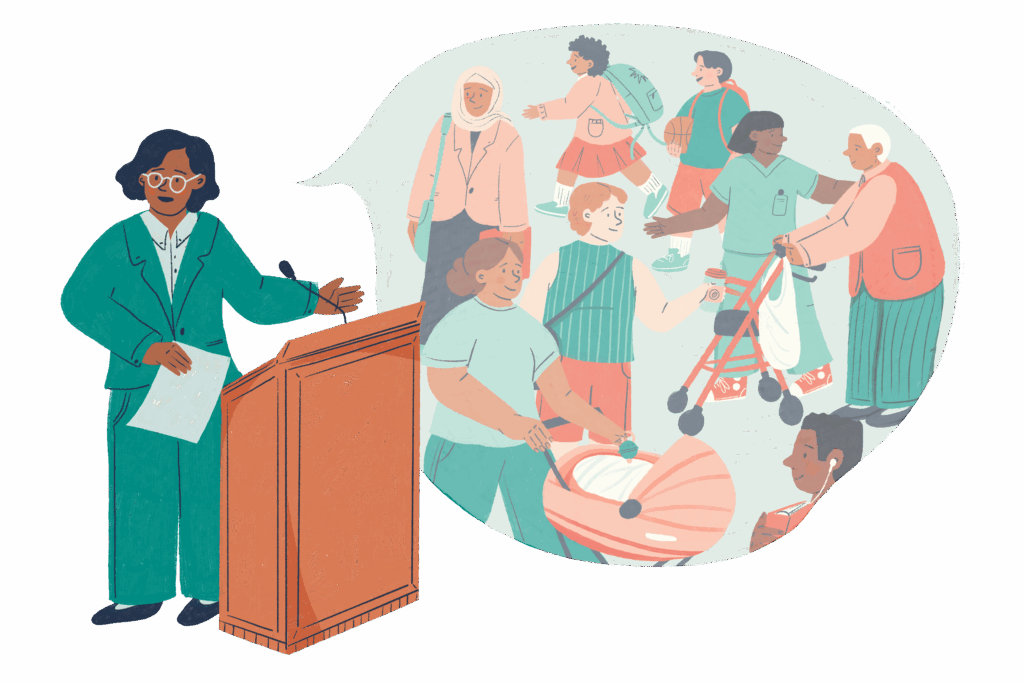
Interveners can help the court by:
- Providing a unique perspective on the issues in the case, drawing on their expertise
- Highlighting the potential impact of a decision on individuals or communities not involved in the case
Interveners make an impact!
A study at the Supreme Court level found that judges vote more conservatively when there’s a conservative intervener, and more liberally when there’s a liberal or neutral intervener.
Ahluwalia v. Ahluwalia is a family law case that was heard by the Supreme Court in February 2025. Here are the key facts of the case:
- Throughout their marriage, Mr. Ahluwalia abused Mrs. Ahluwalia
- Mrs. Ahluwalia started divorce proceedings
- She asked for damages for the family violence she suffered during the marriage
- The trial judge created a new tort* of family violence to compensate Mrs. Ahluwalia for the family violence she suffered
- The tort of family violence was revoked on appeal, with the appeal court saying that existing torts including battery, assault, and intentional infliction of emotional distress are sufficient in addressing the harms caused by family violence
The case was appealed again, this time to the Supreme Court of Canada, which was tasked with deciding whether or not to reinstate the tort of family violence that was created by the trial judge.
*A tort is a legal term for when a person does something wrong that causes harm or loss to another person. If someone commits a tort, the victim can go to court to receive damages, or compensation. There are different kinds of torts that are recognized by the courts, such as battery and assault.
Can you think of reasons why an outside party, whether that’s your organization or another person or organization, might have an interest or stake in Ahluwalia v. Ahluwalia?
Here are two key reasons that this case was considered significant by many GBV advocates:
- A tort of family violence has the potential to impact all survivors of family violence, in that it would provide them a more straightforward route to get damages for the violence they experienced
- It would also have a legitimizing effect – naming family violence as distinct from assault, battery, etc.
Many GBV organizations intervened in Ahluwalia v. Ahluwalia before the Supreme Court. Hear two of those organizations, Disabled Women’s Network of Canada (DAWN) and Action ontarienne contre la violence faite aux femmes, talk about their experiences in the following videos:
Where do interventions happen?
The interveners in Ahluwalia v. Ahluwalia appeared before the Supreme Court as part of an appeal, but there are other types of legal proceedings where interventions can happen:
Court cases:
- First level of a court case
- Where evidence gets introduced
- Also involve legal arguments
- Can be decided by a judge, or a judge and a jury
- Second (or third) level of a court case
- Much rarer for evidence to be introduced; lots of legal arguments
- Focus on whether the court below made a mistake
- Decided by one or more judges
Other legal proceedings:
- Not court cases, but sometimes look like them
- Set up by provincial and federal governments
- Will involve evidence, legal arguments, and policy considerations
- Investigate issues of serious concern, often to see how similar issues might be prevented in the future
- Usually run by one or more commissioners (who can be judges, but do not need to be)
- Examples include the National Inquiry into Missing and Murdered Indigenous Women and Girls and the Mass Casualty Commission
- Not court cases, but have some similarities
- Look at the circumstances related to a death
- Will involve evidence, legal arguments, policy considerations
- Usually run by a coroner, a judge, or a lawyer, and may involve a jury
- Examples include the Renfrew County Inquest and the 2024 inquest into the deaths of 4 women at an emergency shelter in Whitehorse
Note: You technically don’t “intervene” in a public inquiry or coroner’s inquest/fatality inquiry, but you participate in a process that is very similar to an intervention, which is why we’ve included them here. For the rest of this module, we’ll be focusing on interventions in court cases.
How can gender-based violence (GBV) advocates intervene?
Different courts may have slightly different rules for admitting interveners, but in general, interveners must have:
- A direct/substantial interest in the case
- A unique and useful perspective/expertise on the issue(s)
You also cannot raise new issues or add new evidence.

Activity: Would they qualify in Ahluwalia v. Ahluwalia?
Take a look at the following fictional examples of organizations who want to intervene in Ahluwalia v. Ahluwalia. Based on the criteria for admitting interveners, do you think they would qualify?
Remember, the issue before the court is whether to create a new tort of family violence, and interveners must:
- Have a direct/substantial interest in the case
- Bring a unique and useful perspective/expertise on the issue
- Not raise new issues or add new evidence
1) A women’s shelter applies to intervene. They plan to focus their intervention on why family violence is different from other types of violence like assault or battery.
Yes, they would qualify.
- They have a substantial interest in the case, as a tort of family violence would impact their clients who experience family violence
- They bring a unique and useful perspective as experts in GBV
- They don’t raise any new issues or add new evidence, instead sticking to the issue at hand, which is the tort of family violence
2) An immigrant women’s organization plans to intervene. They plan to highlight the unique challenges that immigrant women experiencing family violence face in seeking justice, and how a tort of family violence could help.
Yes, they would qualify.
- They have a substantial interest in the case, as a tort of family violence would impact their clients who experience family violence
- They bring a unique and useful perspective as an organization with experience supporting immigrant women survivors of family violence
- They don’t raise any new issues or add new evidence, instead sticking to the issue at hand, which is the tort of family violence
3) A human rights organization applies to intervene. They plan to argue for the creation of torts that encompass a range of human rights violations, including a tort of forced marriage.
No, they wouldn’t qualify
- They have a substantial interest in the case, as GBV is a human rights issue and a tort of family violence could contribute to the rights of survivors
- However, because their argument is focused on the creation of human right related torts more generally, their perspective isn’t useful to the court, which is tasked with deciding whether to specifically create a tort of family violence
- Further, they bring new issues to the table (other potential torts, including a tort of forced marriage) which disqualifies them from intervening
I think I qualify! Now what?
Determining whether you qualify to intervene in a case is a key step in getting involved in an intervention. Watch this video about LEAF’s intervention in Ahluwalia v. Ahluwalia to learn about the intervention process from start to finish:
For a more detailed step-by-step look at the process, take a look at this factsheet.
Intervening is an FSL strategy that allows GBV advocates to have their say in court cases that involve issues impacting survivors and their communities. By presenting their unique perspectives before the courts, GBV interveners have the opportunity to influence outcomes in cases that may have far-reaching impacts.